Monday, April 19, 2010

House of Numbers CGI to screen at the Melbourne Int'l Animation Festival


The computer graphics created for House of Numbers has been invited to screen in the 10th annual Melbourne International Animation Festival.

CGI artist Scott Meador and graphics supervisor Jim Lockhart took us inside the body, creating moving imagery of the HIV replication cycle hypothesis. Click here to see a video simultaneously comparing the basic grey 3D model concept, the 3D render, and the final composite.


 Information about the Melbourne Int'l Animation Festival:


Get ready to strap yourselves in for a nine day blast of animation from around the world in the 10th edition of the Melbourne International Animation Festival! This will be your only opportunity in Australia to see such a comprehensive line-up of current animated short films in competition and specially curated programs, that highlight recent productions and absolute gems from the archive. MIAF aims to challenge and inspire audiences with thematic, visual and technical diversity from award winners, outstanding industry veterans and those wonderful newcomers who are exploring their talent on screen for the very first time.

In 2010 MIAF celebrates our 10th anniversary! Woohoo! As well as the regular avalanche of animated goodness covering the best recently released and historical animation, we have three special highlight programs:

10 Years of International Highlights
10 Years of Australian Highlights
10 Years of Late Night Bizarre 

 
We’ve received more than 12,000 entries, screened more than 2,500 films and had some of the most talented animators in the world come and hang with us! These programs will review some of the hits, misses and should-a-beens!! 


Sunday, April 18, 2010

Expectant HIV/Aids women to start on ARV earlier - WHO


By Halima Abdallah
Posted Monday, April 19 2010 at 00:00


HIV-positive pregnant women will now start on antiretroviral in the 14th week of their pregnancy, according to World Health Organisation’s revised guideline on prevention of mother to child transmission of HIV.
The revised guidelines, based on those of 2006, recommend that all HIV-positive pregnant women be given ARVs starting at 14 weeks and continuing through the end of the breastfeeding, to reduce the risk of HIV transmission and improve the infant’s chance of survival. An earlier start to antiretroviral treatment boosts the immune system and reduces the risks of HIV-related diseases and deaths. 
The 2006 guidelines recommended antiretroviral therapy (ART) in the third trimester (beginning at 28 weeks). At the time, there was insufficient evidence on the protective effect of ARVs during breastfeeding. However since then, studies and trials have demonstrated that starting ARV earlier reduces rates of death and disease and increases the efficacy of ARVs in preventing transmission to the infant while breastfeeding.
The latest guideline issued in November 2009, recommends that mothers should continue breastfeeding even when they are positive as they take the drugs with their babies.
“We did a study in National Referral Hospital Mulago and found that the risks of death were higher in those children who were not breastfed because they were prone to diseases like diarrhoea,” Ministry of Health Principal Medical Officer in charge of Child Health Jessica Sabiti said.
The guidelines also recommend that once a mother has selected breastfeeding or providing formula milk, she should do so exclusively and not mix the two. She can choose to boil the breast milk up to 60 degrees, before feeding it to the baby.
“Mixing breast milk and other formula milk enhances transmission because formula feeds causes perforation in the baby’s digestive system when given too early. When the baby is breastfed, the mother’s milk that contains the virus infiltrates the baby’s body through the perforations,” Jessica said.

Saturday, April 17, 2010

United States pledges $2.7 billion for Kenya HIV battle


By Jeremy Clarke, Reuters

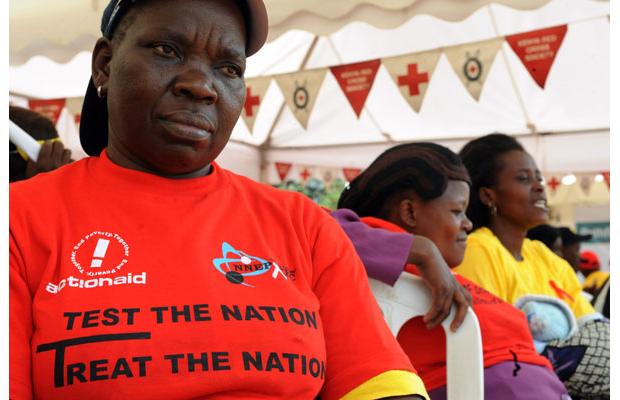
A health worker at the Kenyatta International Centre on December 1, 2009 during celebrations for World AIDS Day in Nairobi, Kenya. The United States has committed $2.7 billion to help fight HIV infection in Kenya where more than a million people are living with the disease.

Photograph by: Simon Maina, AFP/Getty Images

NAIROBI – The United States committed $2.7 billion on Wednesday to help fight HIV infection in Kenya where more than a million people are living with the disease.

The pledge is part of the largest U.S. foreign aid program devoted to a single disease -- the President's Emergency Plan for AIDS Relief -- and has been lauded as a bright spot of former President George W. Bush's tenure.

The money, which is to be dispersed over the next five years, represents a 112 percent increase in funding for the program in Kenya, east Africa's largest economy. It is seen by the United States as an enhancement of a successful program.

"Kenya is now the biggest recipient of this program in the world, more than South Africa," U.S. Ambassador Michael Ranneberger told reporters in Nairobi.

He said the agreement with Nairobi meant the government was expected to increase direct budget support for the fight against HIV/AIDS by a minimum of 10 percent annually.

Kenyan Finance Minister Uhuru Kenyatta said the effect of the HIV virus and AIDS on the Kenyan economy was great.

"Studies done assessing the effect of HIV/AIDS on economic growth in Africa show that we lose about 2 percentage points in terms of growth. This is due to the negative impact of HIV/AIDS impact on productivity of labor," he said.

The program will include caring for more than 550,000 orphans and vulnerable children, as well as helping manage other related co-infections such as Tuberculosis, Kenyatta said.

Sub-Saharan Africa accounts for 72 percent of the world's AIDS-related deaths with 1.4 million last year, while an estimated 1.9 million people in the region were newly infected with HIV.
In Kenya, AIDS-related deaths have fallen by 29 percent since 2002.


Thursday, April 15, 2010

Groups Protest Segregation of Inmates With H.I.V.

Published: April 14, 2010 - NY Times
By ERIK ECKHOLM

In Alabama, prisoners infected with H.I.V. must wear white armbands and live in special units. In South Carolina, infected men have blue dots on their badges and are housed in a maximum-security prison; female prisoners carry the name of the H.I.V./AIDS dorm on their uniforms. The two states are the last to segregate and put blanket restrictions on H.I.V.-positive inmates and on Wednesday, rights groups called for change, saying the policies violate federal and international guidelines. Infected prisoners’ chances of early release and help in re-entering society are harmed as well, according to a report issued by the American Civil Liberties Union and Human Rights Watch. South Carolina bars them from participating in work-release, for example, and Alabama limits such opportunities. Prison officials in the two states say that segregation is necessary to prevent the spread of H.I.V. and provide specialized medical care.

Wednesday, April 14, 2010

H&M launches third Fashion Against AIDS! campaign

Inspired by the summer festival season, H&M is launching it's third Fashion Against AIDS! campaign with a collection of rock and roll summer styles, with 25% of the proceeds going to youth HIV/AIDS awareness projects.

"It is very important to make people aware of the problem with AIDS and HIV and we want to contribute in the fight against the disease by donating some of the sales from this collection,” says Ann-Sofie Johansson, H&M’s head of design, in a press release.

Described as "a mix of rock with bohemia and glamour with added ethnic touches," the girls collection consists of ready-for-summer denim hotpants, patterned leggings, embellished tunic tops, maxi-dresses, leather jackets, gladiator shoes, chunky bracelets, wide belts , and beaded necklaces.

And for guys who want to look like they're in the band, the boy's collection offers slim blazers and jackets, faded and patched denim jeans and cropped shorts, embellished waistcoats, paisley vests and the "essential rocker’s hat."

Of course if your headed out to a summer music festival, your going to need supplies for camping out. For this reason the collection offers rocker-chic tents, sleeping bags and folding chairs, along with guys and gals themed toiletry kits.

Born to rock but sticking close to home this summer? The collection offers a quartet of headphones in vibrant patterns and colors so you can rock out even if your not at a hot concert.

Hitting stores May 20th and priced from just $2.95 to $79.95, the Fashion Against Aids! collection allows you to give back at a bargain price.

City Endorses New Policy for Treatment of H.I.V.

Published: April 2, 2010 - By SABIN RUSSELL - NY Times 

In a major shift of H.I.V. treatment policy, San Francisco public health doctors have begun to advise patients to start taking antiviral medicines as soon as they are found to be infected, rather than waiting — sometimes years — for signs that their immune systems have started to fail. 

The new, controversial city guidelines, to be announced next week by the Department of Public Health, may be the most forceful anywhere in their endorsement of early treatment against H.I.V., the virus that causes AIDS.

Ever since combinations of antiviral drugs were found to slow progression of the disease in the mid-1990s, doctors and patients have wrestled with the question of when to begin a lifetime regimen of costly and sometimes toxic medicines. The answer remains in dispute, but public health leaders here are now making a case for a change.

Behind the policy switch is mounting evidence that patients who start early are more likely to live longer, and less likely to suffer a variety of ailments — including heart disease, kidney failure and cancer — that plague long-term survivors. Studies suggest that in the early years of infection, when a patient may show few signs of immune system failure, the virus is in fact causing permanent damage that becomes evident later.

For instance, in older patients who finally start taking the drugs, the effects of chronic inflammation take their toll.

“The impact on health risk is comparable to that of diabetes,” said Dr. Steven G. Deeks, a researcher at the University of California, San Francisco. “Their immune system may look like that of someone 30 years older.”

Dr. Diane V. Havlir, chief of the H.I.V./AIDS division at San Francisco General Hospital, said the new policy was already in effect for her patients. Although a decision whether or not to take the medicine rests with the patient, all those testing positive for H.I.V. will be offered combination therapy, with advice to pursue it.
“The history of H.I.V. disease has always been about change,” she said. “We pride ourselves on working quickly with new data.”

At the public hospital’s H.I.V. clinic, a 30-year-old man is mulling advice from Dr. C. Bradley Hare to start on antiviral drugs. He was infected four years ago, but his T-cell count, a measure of infection-fighting white blood cells, is 735, comparable to that of an uninfected, healthy adult. He is buff and athletic and feels good.

The man has decided to keep waiting. “Once you start the drugs, you can’t stop,” he said. “You know how they say, ‘If it ain’t broke, don’t fix it?’ ”

Dr. Hare has been following research on early treatment, and for the last several years he has asked his patients to think about it. Now, he is recommending it outright. He said most of his patients did not have serious problems with drug side effects. “A lot of times they have a sense of relief when they start the meds,” he said.

The turning point in San Francisco’s thinking may have been a study in The New England Journal of Medicine on April 1, 2009, that compared death rates among thousands of North American H.I.V. patients. Dr. Mari Kitahata, an epidemiologist at the University of Washington, and her team of researchers found that patients who put off therapy until their immune system showed signs of damage had a nearly twofold greater risk of dying — from any cause — than those who started treatment when their T-cell counts were above 500.

There is another motivation prompting the change. Reducing the level of virus in the population of infected people may reduce the spread of the disease.

“I do anticipate it will drive down the rates of new infections,” Dr. Mitchell H. Katz, San Francisco director of public health, said. “It’s a nice, secondary benefit of this new policy.”

Dr. Katz said that despite cuts in health budgets, a policy to add to the number of H.I.V. patients taking expensive drugs made economic sense. “H.I.V. medications have been continually proven to be cost effective,” he said, “and in this case, it is also the right thing to do.”

The program is being carried out without a clear picture of its cost to city and state health agencies. Antiviral drugs can cost $12,000 a year, consuming $350 million of the budget of California AIDS Drug Assistance Plan.

Dr. Michelle Roland, chief of the state’s Office of AIDS, said she and her counterparts across the country were working with the Centers for Disease Control and Prevention to estimate the added cost of early treatment.

In San Francisco, up to 2,000 people know they are H.I.V. positive, have healthy T-cell counts and are not yet on treatment, according to the city. Cost estimates are complicated by unknowns, like the number of patients choosing to participate, how close they were to needing treatment under the previous system and whether they had private insurance.

When the first combinations of AIDS drugs came out in 1996, the thinking was “hit early, and hit hard.” But as patients battled nasty side effects, like diarrhea and disfiguring shifts in body fat, therapy was deferred until T-cell counts fell as low as 200.

Today, with safer drugs, quick viral suppression is back in fashion.

“The field is moving, inexorably, to earlier and earlier therapy,” said Dr. Anthony Fauci, director of the National Institutes for Allergy and Infectious Diseases. He called San Francisco’s decision “an important step in that direction.”
But the proposal is highly controversial, even in San Francisco. “It’s just too risky,” said Dr. Jay Levy, the U.C.S.F. virologist who was among the first to identify the cause of AIDS. The new drugs may be less toxic, Dr. Levy said, but no one knows the effects of taking them for decades.

San Francisco’s decision follows a split vote in December by a 38-member federal panel on treatment guidelines. Only half of the H.I.V. experts gathered by the Department of Health and Human Services favored starting drugs in patients with healthy levels of more than 500 T-cells.

One panel member, James D. Neaton of the University of Minnesota School of Public Health, contends that a rigorous, randomized clinical trial is needed to show whether early intervention works. The risks of early treatment — giving powerful drugs to people at low risk of disease — - could outweigh the “modest predicted benefit,” Dr. Neaton wrote in an e-mail message. “That is why we do randomized trials.”

In 2009, the University of Minnesota began a study to find that proof. Results are expected in 2015.
Dr. Lisa C. Capaldini, who runs an AIDS practice in the Castro district, also has strong reservations. “H.I.V. behaves differently in different people,” she said.

Although Dr. Capaldini recognizes that today’s drugs are a vast improvement over earlier therapies, the program, she said “is not ready for prime time.”

But the changes make sense to Dr. Stephen Follansbee, director of H.I.V. Services for Kaiser Permanente in San Francisco, who oversees a program that covers 2,100 people with the virus.
“The idea of living in happy symbiosis with this virus is delusional,” Dr. Follansbee said. “If you have a fire in one part of the house, but not in the living room, you don’t wait for it to reach the living room before you call the fire department.”


Tuesday, April 13, 2010

Miami man admits guilt in $60 mln healthcare scam

* Scheme involved recruits from Cuban immigrant community

* Suspect spent nearly $3 million on luxury cars alone

MIAMI, April 13 (Reuters) - A Miami man has pleaded guilty to a Medicare fraud scheme that sought to cheat the U.S. healthcare system out of more $60 million, authorities said on Tuesday.

The U.S. Attorney's Office for the Southern District of Florida said Ihosvany Marquez confessed to overseeing a criminal operation that submitted at least $61 million in false claims to Medicare for the treatment of patients with HIV, AIDS, cancer and a variety of other ailments at eight Miami and Orlando-area health clinics.

Medicare, the federal health insurer for more than 43 million elderly and disabled Americans, paid nearly $24 million of the bogus claims.

The returns were so good that Marquez -- a former high school pitching ace who went on to have a short-lived career in minor league baseball -- spent millions of dollars on jewelry, watches, luxury cars and race horses, according to court records.

As part of his plea agreement, he admitted to laundering the healthcare fraud proceeds through a Miami-area car dealership and through two Miami check cashing stores, Pelly Box Lunch and La Bamba Check Cashing, authorities said.

He and an unidentified number of co-conspirators, all of whom were indicted separately, concealed their involvement in the scheme by recruiting nominee or "straw" owners for each healthcare clinic they operated, the U.S. Attorney's Office said.

It said the nominal owners, mostly from the closely knit Cuban immigrant community, were paid large sums of cash to sign corporate and bank records and other documents before fleeing the country to avoid arrest.

Florida, where healthcare fraud has replaced the drug trade as the crime of choice among many felons, has long been has long been known as the capital of Medicare fraud.

The cases often involve multimillion-dollar schemes featuring bogus suppliers of durable medical equipment such as wheelchairs and sham infusion therapies for the treatment of HIV and AIDS. (Reporting by Tom Brown; Editing by Cynthia Osterman)