


Monday, February 07, 2011 by: Brent Leung
(NaturalNews) "The first and only person ever to be cured of HIV/AIDS is a leukemia patient treated in Berlin with HIV-resistant stem cells." This statement by Daniel J. DeNoon from WebMD comes in response to a paper published this month by the American Society of Hematology on an individual named Timothy Brown who was allegedly cured of HIV infection.
But was he the first to be cured of HIV?
In the 1990s, boxing heavyweight champion Tommy Morrison tested positive for HIV, according to the screening and confirmatory tests he took. He also sustained a viral load and maintained an antiretroviral regimen for a period of time. In 2007 he tested negative for HIV multiple times and was allowed to return to the ring.
Then a few years ago in South Africa, I spoke with doctors whose patients tested positive, but after taking natural medications for their HIV infection they then tested negative.
The multiple cases above are not isolated, as there is much testimony documented regarding scenarios where people who tested positive were later found to be negative. These instances beg the question of whether these individuals were cured of HIV. An equally important question is: were they ever even infected with HIV in the first place?
As shown in the film House of Numbers and in additional interviews taken for the film, the issues with HIV testing are enormous.
Watch: How Accurate is the HIV Confirmation Test
http://naturalnews.tv/v.asp?v=E9FEA...
Before we can state that someone has been cured of HIV, I would like to see the scientific community come to a consensus on criteria for testing whether someone is infected with HIV. It is not plausible to determine if someone is cured unless it is proven that they are infected in the first place.
Another question that should be posed is why so much attention is being paid around the new study published by the American Society of Hematology when Luc Montagnier, the Nobel Laureate for discovering HIV, has already testified that it is possible for HIV to be cured naturally, without drugs.
See the interview with Luc Montagnier where he makes this earth shattering statement: http://www.youtube.com/watch?v=WQoN...
Intrigued by this study, I sent an inquiry to establishment scientists and The Perth Group for a comment. The Perth Group provided a brief response with a commitment to providing a full breakdown and response of the paper. The Perth Group writes:
"In the Subjects, Materials, and Methods Subjects section of this paper one reads: In February 2007, an HIV-infected patient underwent stem cell transplantation (SCT) due to a relapse of AML with a graft consisting of CCR5A32/A32 donor cells. The pre-transplant conditioning regimen included 100 mg/m2 of amsacrine, 30 mg/m2 of fludarabine, 2 g/m2 of cytarabine (day -12 until -9), 60 mg/kg of cyclophosphamide (days -4 and -3), 5.5 mg/kg of rabbit antithymocyte globuline (in three doses between day -3 and -1), and a 400 cGy total body irradiation (TBI; day -5). ART was discontinued on the day of transplantation, and 13 months later the patient received a second transplant with CCR5A32/A32 stem cells from the same donor due to a second relapse of AML. The conditioning regimen consisted of 100 mg/m2 of cytarabine (day -7 until day -1), 6 mg/m2 of gemtuzumab (day -7 and day -1), and a 200 cGy TBI (day -1)... Twelve months post-transplant, the patient underwent liver biopsy and histological examination confirmed GvHD grade I that was controlled with adaption of immunosuppressive therapy (cyclosporine A, methylprednisolone, mycophenolate mofetil)."
In other words, this particular patient received two transplants of foreign white blood cells, eight different drugs, anti-lymphocyte serum, and body irradiation, and had other drugs in the form of antiretroviral therapy, discontinued.
According to the title, all of this led to 'CURE OF HIV INFECTION BY CCR5A32/A32 SCT.' The administration of CCR5A32/A32 SCT constitutes only one part of a much larger experiment involving multiple drug and other therapies. All of these must be regarded as separate experiments, making it impossible to know exactly what 'cured the HIV infection.' If someone with hypertension is given multiple therapies, including non-pharmacological therapies, and blood pressure returns to normal, how can anyone say which treatment was responsible?
However, in order for the findings of the study to even have a valid platform for discussion, there must first be evidence that HIV exists. Until then, the question of whether someone can be cured of AIDS is moot.
Visit www.houseofnumbers.com to learn more about the HIV debate.
Showing posts with label HIV. Show all posts
Showing posts with label HIV. Show all posts
Monday, February 7, 2011


Sunday, January 30, 2011
Luc Montagnier, Nobel Prize Winner, Takes Homeopathy Seriously

Dr. Luc Montagnier, the French virologist who won the Nobel Prize in 2008 for discovering the AIDS virus, has surprised the scientific community with his strong support for homeopathic medicine.
In a remarkable interview published in Science magazine of December 24, 2010, (1) Professor Luc Montagnier, has expressed support for the often maligned and misunderstood medical specialty of homeopathic medicine. Although homeopathy has persisted for 200+ years throughout the world and has been the leading alternative treatment method used by physicians in Europe, (2) most conventional physicians and scientists have expressed skepticism about its efficacy due to the extremely small doses of medicines used.
Most clinical research conducted on homeopathic medicines that has been published in peer-review journals have shown positive clinical results,(3, 4) especially in the treatment of respiratory allergies (5, 6), influenza, (7) fibromyalgia, (8, 9) rheumatoid arthritis, (10) childhood diarrhea, (11) post-surgical abdominal surgery recovery, (12) attention deficit disorder, (13) and reduction in the side effects of conventional cancer treatments. (14) In addition to clinical trials, several hundred basic science studies have confirmed the biological activity of homeopathic medicines. One type of basic science trials, called in vitro studies, found 67 experiments (1/3 of them replications) and nearly 3/4 of all replications were positive. (15, 16)
In addition to the wide variety of basic science evidence and clinical research, further evidence for homeopathy resides in the fact that they gained widespread popularity in the U.S. and Europe during the 19th century due to the impressive results people experienced in the treatment of epidemics that raged during that time, including cholera, typhoid, yellow fever, scarlet fever, and influenza.
Montagnier, who is also founder and president of the World Foundation for AIDS Research and Prevention, asserted, "I can't say that homeopathy is right in everything. What I can say now is that the high dilutions (used in homeopathy) are right. High dilutions of something are not nothing. They are water structures which mimic the original molecules."
Here, Montagnier is making reference to his experimental research that confirms one of the controversial features of homeopathic medicine that uses doses of substances that undergo sequential dilution with vigorous shaking in-between each dilution. Although it is common for modern-day scientists to assume that none of the original molecules remain in solution, Montagnier's research (and other of many of his colleagues) has verified that electromagnetic signals of the original medicine remains in the water and has dramatic biological effects.
Montagnier has just taken a new position at Jiaotong University in Shanghai, China (this university is often referred to as "China's MIT"), where he will work in a new institute bearing his name. This work focuses on a new scientific movement at the crossroads of physics, biology, and medicine: the phenomenon of electromagnetic waves produced by DNA in water. He and his team will study both the theoretical basis and the possible applications in medicine.
Montagnier's new research is investigating the electromagnetic waves that he says emanate from the highly diluted DNA of various pathogens. Montagnier asserts, "What we have found is that DNA produces structural changes in water, which persist at very high dilutions, and which lead to resonant electromagnetic signals that we can measure. Not all DNA produces signals that we can detect with our device. The high-intensity signals come from bacterial and viral DNA."
Montagnier affirms that these new observations will lead to novel treatments for many common chronic diseases, including but not limited to autism, Alzheimer's disease, Parkinson's disease, and multiple sclerosis.
Montagnier first wrote about his findings in 2009, (17) and then, in mid-2010, he spoke at a prestigious meeting of fellow Nobelists where he expressed interest in homeopathy and the implications of this system of medicine. (18)
French retirement laws do not allow Montagnier, who is 78 years of age, to work at a public institute, thereby limiting access to research funding. Montagnier acknowledges that getting research funds from Big Pharma and certain other conventional research funding agencies is unlikely due to the atmosphere of antagonism to homeopathy and natural treatment options.
Support from Another Nobel Prize winner
Montagnier's new research evokes memories one of the most sensational stories in French science, often referred to as the 'Benveniste affair.' A highly respected immunologist Dr. Jacques Benveniste., who died in 2004, conducted a study which was replicated in three other university laboratories and that was published in Nature (19). Benveniste and other researchers used extremely diluted doses of substances that created an effect on a type of white blood cell called basophils.
Although Benveniste's work was supposedly debunked, (20) Montagnier considers Benveniste a "modern Galileo" who was far ahead of his day and time and who was attacked for investigating a medical and scientific subject that orthodoxy had mistakenly overlooked and even demonized.
In addition to Benveniste and Montagnier is the weighty opinion of Brian Josephson, Ph.D., who, like Montagnier, is a Nobel Prize-winning scientist.
Responding to an article on homeopathy in New Scientist, Josephson wrote:
Regarding your comments on claims made for homeopathy: criticisms centered around the vanishingly small number of solute molecules present in a solution after it has been repeatedly diluted are beside the point, since advocates of homeopathic remedies attribute their effects not to molecules present in the water, but to modifications of the water's structure.Following his comments Josephson, who is an emeritus professor of Cambridge University in England, was asked by New Scientist editors how he became an advocate of unconventional ideas. He responded:
Simple-minded analysis may suggest that water, being a fluid, cannot have a structure of the kind that such a picture would demand. But cases such as that of liquid crystals, which while flowing like an ordinary fluid can maintain an ordered structure over macroscopic distances, show the limitations of such ways of thinking. There have not, to the best of my knowledge, been any refutations of homeopathy that remain valid after this particular point is taken into account.
A related topic is the phenomenon, claimed by Jacques Benveniste's colleague Yolène Thomas and by others to be well established experimentally, known as "memory of water." If valid, this would be of greater significance than homeopathy itself, and it attests to the limited vision of the modern scientific community that, far from hastening to test such claims, the only response has been to dismiss them out of hand. (21)
I went to a conference where the French immunologist Jacques Benveniste was talking for the first time about his discovery that water has a 'memory' of compounds that were once dissolved in it -- which might explain how homeopathy works. His findings provoked irrationally strong reactions from scientists, and I was struck by how badly he was treated. (22)Josephson went on to describe how many scientists today suffer from "pathological disbelief;" that is, they maintain an unscientific attitude that is embodied by the statement "even if it were true I wouldn't believe it."
Even more recently, Josephson wryly responded to the chronic ignorance of homeopathy by its skeptics saying, "The idea that water can have a memory can be readily refuted by any one of a number of easily understood, invalid arguments."
In the new interview in Science, Montagnier also expressed real concern about the unscientific atmosphere that presently exists on certain unconventional subjects such as homeopathy, "I am told that some people have reproduced Benveniste's results, but they are afraid to publish it because of the intellectual terror from people who don't understand it."
Montagnier concluded the interview when asked if he is concerned that he is drifting into pseudoscience, he replied adamantly: "No, because it's not pseudoscience. It's not quackery. These are real phenomena which deserve further study."
The Misinformation That Skeptics Spread
It is remarkable enough that many skeptics of homeopathy actually say that there is "no research" that has shows that homeopathic medicines work. Such statements are clearly false, and yet, such assertions are common on the Internet and even in some peer-review articles. Just a little bit of searching can uncover many high quality studies that have been published in highly respected medical and scientific journals, including the Lancet, BMJ, Pediatrics, Pediatric Infectious Disease Journal, Chest and many others. Although some of these same journals have also published research with negative results to homeopathy, there is simply much more research that shows a positive rather than negative effect.
Misstatements and misinformation on homeopathy are predictable because this system of medicine provides a viable and significant threat to economic interests in medicine, let alone to the very philosophy and worldview of biomedicine. It is therefore not surprising that the British Medical Association had the sheer audacity to refer to homeopathy as "witchcraft." It is quite predictable that when one goes on a witch hunt, one inevitable finds "witches," especially when there are certain benefits to demonizing a potential competitor (homeopathy plays a much larger and more competitive role in Europe than it does in the USA).
Skeptics of homeopathy also have long asserted that homeopathic medicines have "nothing" in them because they are diluted too much. However, new research conducted at the respected Indian Institutes of Technology has confirmed the presence of "nanoparticles" of the starting materials even at extremely high dilutions. Researchers have demonstrated by Transmission Electron Microscopy (TEM), electron diffraction and chemical analysis by Inductively Coupled Plasma-Atomic Emission Spectroscopy (ICP-AES), the presence of physical entities in these extreme dilutions. (24) In the light of this research, it can now be asserted that anyone who says or suggests that there is "nothing" in homeopathic medicines is either simply uninformed or is not being honest.
Because the researchers received confirmation of the existence of nanoparticles at two different homeopathic high potencies (30C and 200C) and because they tested four different medicines (Zincum met./zinc; Aurum met. /gold; Stannum met./tin; and Cuprum met./copper), the researchers concluded that this study provides "concrete evidence."
Although skeptics of homeopathy may assume that homeopathic doses are still too small to have any biological action, such assumptions have also been proven wrong. The multi-disciplinary field of small dose effects is called "hormesis," and approximately 1,000 studies from a wide variety of scientific specialties have confirmed significant and sometimes substantial biological effects from extremely small doses of certain substances on certain biological systems.
A special issue of the peer-review journal, Human and Experimental Toxicology (July 2010), devoted itself to the interface between hormesis and homeopathy. (25) The articles in this issue verify the power of homeopathic doses of various substances.
In closing, it should be noted that skepticism of any subject is important to the evolution of science and medicine. However, as noted above by Nobelist Brian Josephson, many scientists have a "pathological disbelief" in certain subjects that ultimately create an unhealthy and unscientific attitude blocks real truth and real science. Skepticism is at its best when its advocates do not try to cut off research or close down conversation of a subject but instead explore possible new (or old) ways to understand and verify strange but compelling phenomena. We all have this challenge as we explore and evaluate the biological and clinical effects of homeopathic medicines.
REFERENCES:
(1) Enserink M, Newsmaker Interview: Luc Montagnier, French Nobelist Escapes "Intellectual Terror" to Pursue Radical Ideas in China. Science 24 December 2010: Vol. 330 no. 6012 p. 1732. DOI: 10.1126/science.330.6012.1732
(2) Ullman D. Homeopathic Medicine: Europe's #1 Alternative for Doctors. http://www.huffingtonpost.com/dana-ullman/homeopathic-medicine-euro_b_402490.html
(3) Linde L, Clausius N, Ramirez G, et al., "Are the Clinical Effects of Homoeopathy Placebo Effects? A Meta-analysis of Placebo-Controlled Trials," Lancet, September 20, 1997, 350:834-843.
(4) Lüdtke R, Rutten ALB. The conclusions on the effectiveness of homeopathy highly depend on the set of analyzed trials. Journal of Clinical Epidemiology. October 2008. doi: 10.1016/j.jclinepi.2008.06/015.
(5) Taylor, MA, Reilly, D, Llewellyn-Jones, RH, et al., Randomised controlled trial of homoeopathy versus placebo in perennial allergic rhinitis with overview of four trial Series, BMJ, August 19, 2000, 321:471-476.
(6) Ullman, D, Frass, M. A Review of Homeopathic Research in the Treatment of Respiratory Allergies. Alternative Medicine Review. 2010:15,1:48-58. http://www.thorne.com/altmedrev/.fulltext/15/1/48.pdf
(7) Vickers AJ. Homoeopathic Oscillococcinum for preventing and treating influenza and influenza-like syndromes. Cochrane Reviews. 2009.
(8) Bell IR, Lewis II DA, Brooks AJ, et al. Improved clinical status in fibromyalgia patients treated with individualized homeopathic remedies versus placebo, Rheumatology. 2004:1111-5.
(9) Fisher P, Greenwood A, Huskisson EC, et al., "Effect of Homoeopathic Treatment on Fibrositis (Primary Fibromyalgia)," BMJ, 299(August 5, 1989):365-6.
(10) Jonas, WB, Linde, Klaus, and Ramirez, Gilbert, "Homeopathy and Rheumatic Disease," Rheumatic Disease Clinics of North America, February 2000,1:117-123.
(11) Jacobs J, Jonas WB, Jimenez-Perez M, Crothers D, Homeopathy for Childhood Diarrhea: Combined Results and Metaanalysis from Three Randomized, Controlled Clinical Trials, Pediatr Infect Dis J, 2003;22:229-34.
(12) Barnes, J, Resch, KL, Ernst, E, "Homeopathy for Post-Operative Ileus: A Meta-Analysis," Journal of Clinical Gastroenterology, 1997, 25: 628-633.
(13) M, Thurneysen A. Homeopathic treatment of children with attention deficit hyperactivity disorder: a randomised, double blind, placebo controlled crossover trial. Eur J Pediatr. 2005 Dec;164(12):758-67. Epub 2005 Jul 27.
(14) Kassab S, Cummings M, Berkovitz S, van Haselen R, Fisher P. Homeopathic medicines for adverse effects of cancer treatments. Cochrane Database of Systematic Reviews 2009, Issue 2.
(15) Witt CM, Bluth M, Albrecht H, Weisshuhn TE, Baumgartner S, Willich SN. The in vitro evidence for an effect of high homeopathic potencies--a systematic review of the literature. Complement Ther Med. 2007 Jun;15(2):128-38. Epub 2007 Mar 28.
(16) Endler PC, Thieves K, Reich C, Matthiessen P, Bonamin L, Scherr C, Baumgartner S. Repetitions of fundamental research models for homeopathically prepared dilutions beyond 10-23: a bibliometric study. Homeopathy, 2010; 99: 25-36.
(17) Luc Montagnier, Jamal Aissa, Stéphane Ferris, Jean-Luc Montagnier, Claude Lavallee, Electromagnetic Signals Are Produced by Aqueous Nanostructures Derived from Bacterial DNA Sequences. Interdiscip Sci Comput Life Sci (2009) 1: 81-90.
http://www.springerlink.com/content/0557v31188m3766x/fulltext.pdf
(18) Nobel laureate gives homeopathy a boost. The Australian. July 5, 2010. http://www.theaustralian.com.au/news/health-science/nobel-laureate-gives-homeopathy-a-boost/story-e6frg8y6-1225887772305
(19) Davenas E, Beauvais F, Amara J, et al. (June 1988). "Human basophil degranulation triggered by very dilute antiserum against IgE". Nature 333 (6176): 816-8.
(20) Maddox J (June 1988). "Can a Greek tragedy be avoided?". Nature 333 (6176): 795-7.
(21) Josephson, B. D., Letter, New Scientist, November 1, 1997.
(22) George A. Lone Voices special: Take nobody's word for it. New Scientist. December 9, 2006.
(23) Personal communication. Brian Josephson to Dana Ullman. January 5, 2011.
(24) Chikramane PS, Suresh AK, Bellare JR, and Govind S. Extreme homeopathic dilutions retain starting materials: A nanoparticulate perspective. Homeopathy. Volume 99, Issue 4, October 2010, 231-242.
(25) Human and Experimental Toxicology, July 2010: http://het.sagepub.com/content/vol29/issue7/
To access free copies of these articles, see: http://www.siomi.it/siomifile/siomi_pdf/BELLE_newsletter.pdf
Wednesday, November 24, 2010
Daily Pill Greatly Lowers AIDS Risk, Study Finds
By DONALD G. McNEIL Jr. Published: November 23, 2010
Healthy gay men who took an anti-AIDS pill every day were well protected against contracting H.I.V. in a study suggesting that a new weapon against the epidemic has emerged.
In the study, published Tuesday by the New England Journal of Medicine, researchers found that the men taking Truvada, a common combination of two antiretroviral drugs, were 44 percent less likely to get infected with the virus that causes AIDS than an equal number taking a placebo.
But when only the men whose blood tests showed that they had taken their pill faithfully every day were considered, the pill was more than 90 percent effective, said Dr. Anthony S. Fauci, head of the infectious diseases division of the National Institutes of Health, which paid for the study along with the Bill and Melinda Gates Foundation.
“That’s huge,” Dr. Fauci said. “That says it all for me.”
The large study, nicknamed iPrEx, included nearly 2,500 men and was coordinated by the Gladstone Institutes of the University of California, San Francisco.
The results are the best news in the AIDS field in years, even better than this summer’s revelation that a vaginal microbicide protected 39 percent of all the women testing it and 54 percent of those who used it faithfully.
Also, Truvada, a combination of tenofovir and emtricitabine that prevents the virus from replicating, is available by prescription in many countries right now, while the microbicide gel is made in only small amounts for clinical trials.
The protection, known as pre-exposure prophylaxis, is also the first new form available to men, especially men who cannot use condoms because they sell sex, are in danger of prison rape, are under pressure from partners or lose their inhibitions when drunk or high.
It “does not involve getting permission from the other partner, and that’s important,” said Phill Wilson, president of the Black AIDS Institute, which focuses on the epidemic among blacks.
Michel Sidibé, the head of the United Nations agency that fights AIDS, called it “a breakthrough that will accelerate the prevention revolution.”
AIDS experts and the researchers issued several caveats about the study’s limitations, emphasizing that it looked only at gay men and Truvada. More studies, now under way, are needed to see whether the results can be duplicated, whether other antiretroviral drugs will work and whether they will protect heterosexual men and women, prostitutes and drug users who share needles.
There is no medical reason to think the pill would not work in other groups, since it attacks the virus in the blood, not in the vaginal wall as a microbicide does. Pre-exposure prophylaxis became possible only in recent years as newer, less-toxic antiretroviral drugs were developed.
Some scientists fear that putting more people on the drugs will speed the evolution of drug-resistant strains, though that did not occur in the study.
Because Truvada is available now, some clinicians already prescribe it for prophylaxis, Dr. Fauci said, but whether doing so becomes official policy will depend on discussions by the Centers for Disease Control and Prevention, the Food and Drug Administration, medical societies and others, which could take months.
Although the C.D.C. would prefer that doctors wait for further studies, more will probably prescribe the drugs now that this study is out, said Dr. Kevin Fenton, chief of the agency’s AIDS division, so the C.D.C. will soon release suggested guidelines.
The agency will suggest that the drug be prescribed only with close medical supervision and used only with other safe-sex practices.
“The results are encouraging, but it’s not time for gay men to throw away their condoms,” Dr. Fenton said.
AIDS advocacy groups were very excited by the results.
“If you comply with it, this works really well,” said Chris Collins, policy director of amfAR, the Foundation for AIDS Research. “This is too big to walk away from.”
Mitchell Warren, executive director of AVAC, an organization that lobbies for AIDS prevention, called the study “a great day for the fight against AIDS” and said gay men and others at risk needed to be consulted on the next steps.
In the study, 2,499 men in six countries — Brazil, Ecuador, Peru, South Africa, Thailand and the United States — were randomly assigned to take either Truvada or a placebo and were followed for up to three years. For ethical reasons, they were also given condoms, treatment for venereal diseases and advice on safe sex. There were 64 infections in the placebo group and 36 in the group that took Truvada, a 44 percent risk reduction.
Two in the Truvada group turned out to have been infected before the study began. When the remaining 34 were tested, only 3 had any drug in their blood — suggesting that the other 31 had not taken their pills.
Different regimens, like taking the pills not daily but only when sex is anticipated, also need testing.
Also, many men in the study failed to take all of their pills, and some clearly lied about it. For example, some who claimed to take them 50 percent or 90 percent of the time had little or no drug in their bloodstreams.
The pills caused no major side effects, though men who began to show signs of liver problems were taken off them quickly. Some men stopped taking the pills because they disliked relatively minor side effects like nausea and headaches. Also, some stopped bothering once they suspected that they might be taking a placebo.
“People have their own reasons,” Mr. Collins said. “People don’t take their Lipitor every day either.”
A major question now is who will pay for the drug.
In the United States, Truvada, made by Gilead Sciences, costs $12,000 to $14,000 a year. In very poor countries, generic versions cost as little as 40 cents a pill.
Globally, only about 5 million of the 33 million people infected with the AIDS virus are on antiretroviral drugs, and in an era of tight foreign-aid budgets, that number is not expected to rise quickly.
Hundreds of millions of Africans, Eastern Europeans and Asians are at risk and could benefit from prophylaxis, but that would cost tens of billions of dollars.
In this country, insurers and Medicare normally pay for the drugs, and the Ryan White Act covers the cost for the poor, but none of these payers yet have policies on supplying the drugs to healthy people.
No participant in the study developed resistance to tenofovir. Three were found to have strains resistant to emtricitabine, but investigators believe that all three were infected before the study began at levels low enough to have been missed by their first H.I.V. tests.
Another concern was that the participants would become so fearless that they would stop using condoms, but the opposite effect was seen — they used condoms more often and had fewer sex partners. But that can also be a result of simply being enrolled in a study and getting a steady diet of advice on safe sex and free condoms, the investigators said.
Other trials of pre-exposure prophylaxis have about 20,000 volunteers enrolled around the world. Their results are expected over the next two years.
Healthy gay men who took an anti-AIDS pill every day were well protected against contracting H.I.V. in a study suggesting that a new weapon against the epidemic has emerged.
In the study, published Tuesday by the New England Journal of Medicine, researchers found that the men taking Truvada, a common combination of two antiretroviral drugs, were 44 percent less likely to get infected with the virus that causes AIDS than an equal number taking a placebo.
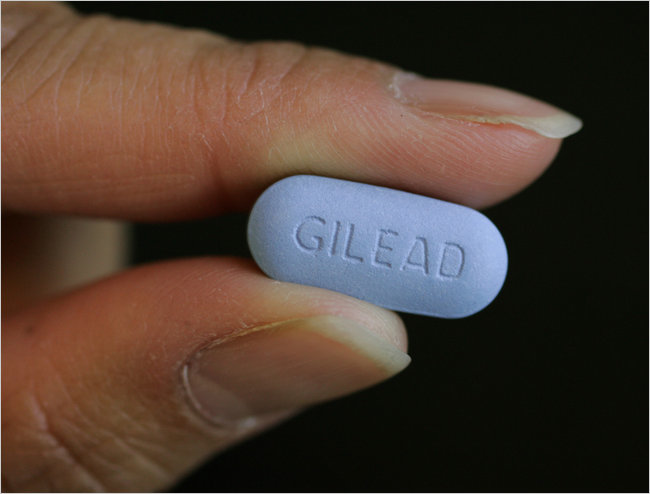 |
| Truvada, by Gilead Sciences, costs around $13,000 a year in the US |
But when only the men whose blood tests showed that they had taken their pill faithfully every day were considered, the pill was more than 90 percent effective, said Dr. Anthony S. Fauci, head of the infectious diseases division of the National Institutes of Health, which paid for the study along with the Bill and Melinda Gates Foundation.
“That’s huge,” Dr. Fauci said. “That says it all for me.”
The large study, nicknamed iPrEx, included nearly 2,500 men and was coordinated by the Gladstone Institutes of the University of California, San Francisco.
The results are the best news in the AIDS field in years, even better than this summer’s revelation that a vaginal microbicide protected 39 percent of all the women testing it and 54 percent of those who used it faithfully.
Also, Truvada, a combination of tenofovir and emtricitabine that prevents the virus from replicating, is available by prescription in many countries right now, while the microbicide gel is made in only small amounts for clinical trials.
The protection, known as pre-exposure prophylaxis, is also the first new form available to men, especially men who cannot use condoms because they sell sex, are in danger of prison rape, are under pressure from partners or lose their inhibitions when drunk or high.
It “does not involve getting permission from the other partner, and that’s important,” said Phill Wilson, president of the Black AIDS Institute, which focuses on the epidemic among blacks.
Michel Sidibé, the head of the United Nations agency that fights AIDS, called it “a breakthrough that will accelerate the prevention revolution.”
AIDS experts and the researchers issued several caveats about the study’s limitations, emphasizing that it looked only at gay men and Truvada. More studies, now under way, are needed to see whether the results can be duplicated, whether other antiretroviral drugs will work and whether they will protect heterosexual men and women, prostitutes and drug users who share needles.
There is no medical reason to think the pill would not work in other groups, since it attacks the virus in the blood, not in the vaginal wall as a microbicide does. Pre-exposure prophylaxis became possible only in recent years as newer, less-toxic antiretroviral drugs were developed.
Some scientists fear that putting more people on the drugs will speed the evolution of drug-resistant strains, though that did not occur in the study.
Because Truvada is available now, some clinicians already prescribe it for prophylaxis, Dr. Fauci said, but whether doing so becomes official policy will depend on discussions by the Centers for Disease Control and Prevention, the Food and Drug Administration, medical societies and others, which could take months.
Although the C.D.C. would prefer that doctors wait for further studies, more will probably prescribe the drugs now that this study is out, said Dr. Kevin Fenton, chief of the agency’s AIDS division, so the C.D.C. will soon release suggested guidelines.
The agency will suggest that the drug be prescribed only with close medical supervision and used only with other safe-sex practices.
“The results are encouraging, but it’s not time for gay men to throw away their condoms,” Dr. Fenton said.
AIDS advocacy groups were very excited by the results.
“If you comply with it, this works really well,” said Chris Collins, policy director of amfAR, the Foundation for AIDS Research. “This is too big to walk away from.”
Mitchell Warren, executive director of AVAC, an organization that lobbies for AIDS prevention, called the study “a great day for the fight against AIDS” and said gay men and others at risk needed to be consulted on the next steps.
In the study, 2,499 men in six countries — Brazil, Ecuador, Peru, South Africa, Thailand and the United States — were randomly assigned to take either Truvada or a placebo and were followed for up to three years. For ethical reasons, they were also given condoms, treatment for venereal diseases and advice on safe sex. There were 64 infections in the placebo group and 36 in the group that took Truvada, a 44 percent risk reduction.
Two in the Truvada group turned out to have been infected before the study began. When the remaining 34 were tested, only 3 had any drug in their blood — suggesting that the other 31 had not taken their pills.
Different regimens, like taking the pills not daily but only when sex is anticipated, also need testing.
Also, many men in the study failed to take all of their pills, and some clearly lied about it. For example, some who claimed to take them 50 percent or 90 percent of the time had little or no drug in their bloodstreams.
The pills caused no major side effects, though men who began to show signs of liver problems were taken off them quickly. Some men stopped taking the pills because they disliked relatively minor side effects like nausea and headaches. Also, some stopped bothering once they suspected that they might be taking a placebo.
“People have their own reasons,” Mr. Collins said. “People don’t take their Lipitor every day either.”
A major question now is who will pay for the drug.
In the United States, Truvada, made by Gilead Sciences, costs $12,000 to $14,000 a year. In very poor countries, generic versions cost as little as 40 cents a pill.
Globally, only about 5 million of the 33 million people infected with the AIDS virus are on antiretroviral drugs, and in an era of tight foreign-aid budgets, that number is not expected to rise quickly.
Hundreds of millions of Africans, Eastern Europeans and Asians are at risk and could benefit from prophylaxis, but that would cost tens of billions of dollars.
In this country, insurers and Medicare normally pay for the drugs, and the Ryan White Act covers the cost for the poor, but none of these payers yet have policies on supplying the drugs to healthy people.
No participant in the study developed resistance to tenofovir. Three were found to have strains resistant to emtricitabine, but investigators believe that all three were infected before the study began at levels low enough to have been missed by their first H.I.V. tests.
Another concern was that the participants would become so fearless that they would stop using condoms, but the opposite effect was seen — they used condoms more often and had fewer sex partners. But that can also be a result of simply being enrolled in a study and getting a steady diet of advice on safe sex and free condoms, the investigators said.
Other trials of pre-exposure prophylaxis have about 20,000 volunteers enrolled around the world. Their results are expected over the next two years.
Monday, November 1, 2010
One in 22 Blacks will get HIV, CDC Report Says
| Written by Special to the NNPA from the Milwaukee Community Journal | |||
| Sunday, 31 October 2010 09:39 | |||
 According to published reports, health officials estimate that one in 22 African Americans will be diagnosed with the AIDS virus in their lifetime — more than twice the risk for Hispanics and eight times that of Whites. The Centers for Disease Control and Prevention reported the numbers last week; noting the lifetime risk is one in 52 for Hispanics, and one in 170 for Whites. According to the report, Asian Americans had the lowest lifetime risk, at about one in 222. The data is no longer considered shocking. Earlier research has shown that Black Americans have an exceptionally high risk of HIV infection. Given the disproportionately high rate of risk for the disease, the Centers for Disease Control and Prevention recently expanded its Act Against AIDS Leadership Initiative to increase prevention efforts in the African-American, Latino, gay and bisexual communities, which are hardest hit by HIV/AIDS. The initiative is a partnership of major community organizations and was launched last year to intensify HIV prevention in the Black community. As part of the new effort, the CDC has reportedly increased funding for the initiative from $10 million to $16 million over six years, brought in eight additional organizational partners, two of which focus specifically on gay Black men, and continues to build on outreach efforts already in place in the Black community. Partners include 100 Black Men of America, American Urban Radio Networks, the Congressional Black Caucus Foundation, the National Action Network, the NAACP, the National Council of Negro Women, the National Council of Negro Women, the National Medical Association and the National Urban League. Source: http://www.washingtoninformer.com/index.php?option=com_content&view=article&id=4840:one-in-22-blacks-will-get-hiv-cdc-report-says&catid=44:health&Itemid=138 |
Saturday, October 16, 2010
Sex Survey at D.C. School Sparks Controversy
Published October 15, 2010 | FoxNews.com

The survey, developed by Metro TeenAIDS, a group dedicated to helping young people fight against HIV/AIDS, was intended to raise awareness of sexually transmitted diseases and teach the children how to avoid them, MyFoxDC.com reported.
But some parents at Hardy Middle School complained that the questions crossed the line, sparking the principal to put the survey on hold, the Georgetown Dish reported.
The students were asked their genders -- whether male, female or transgender. And they were asked to identify themselves as straight, bisexual, gay or lesbian or "not sure."
Other questions included: How sure are you that you know the difference between oral, vaginal, and anal sex? Would know where to get condoms if/when you or a friend needed them? Can correctly put a condom on yourself or your partner?
"Unfortunately, the opt-out letter to parents regarding this unit in the health class went home on the same day that the assessment was administered. As a result, there was not enough time to allow for parental response before the unit began," school officials said in a written statement.
“Raising awareness among students about HIV and AIDS is certainly an important and necessary task schools must carry out, and families have an important role to play in the planning and execution of the sex education curriculum," D.C. Mayor-elect Vincent Gray said in an e-mail to The Georgetown Dish. "I hope that the Hardy school leadership, parents, and contract providers can talk about these recent developments to ensure that no one is surprised in the future.”
Metro TeenAIDS says the survey questions are in line with D.C. standards, which outline the kind of information young people are supposed to get at certain ages, as well as national testing questions on the subject.
To parents who are concerned the survey revealed too much information for a 12-year-old, Metro TeenAIDS' executive director, Adam Tenner, told MyFoxDC.com that most of those 12-year-olds are much more experienced sexually than those parents might think.
“Our local data show that almost 23 percent of middle school students -- and this was in a 2009 survey -- said that they had already had sexual intercourse once,” he said. “We know that we have an STD epidemic that’s 16 times the national average, that our pregnancy rates are three times the national average … so what we know is that young people are sexually active and we need to work together parents, schools, all of us to make sure young people get the information and skills they need to protect themselves.”
Watch House of Numbers to learn more about HIV and AIDS.
Wednesday, September 22, 2010
Inappropriate water kills more than war, Hiv/Aids
Luanda – The director-general of Eduardo dos Santos Foundation (FESA), João de Deus, said Tuesday, in Luanda, that the number of children that dies of intake of inappropriate water in the world is larger than those killed by war’s Hiv-Aids, malaria and road accident.
João de Deus was addressing in his capacity as host for the 14th FESA events.
He on the occasion cited Maude Barlow, in his book “water-blue covenant” that states that as the ecological crisis deepens, so does human crisis.
Water global crisis, he added, became a powerful symbol of the world’s growing inequality. While the rich drink high quality water, whenever they please, millions of poor people only drink contaminated water, which becomes a true evil of humanity.
To him, in addition to the urgent reflections in the scientific field, there is need for this problem to be addressed, which requires a political public health and ethic approach.
The event comprises four panels and during the four days the participants will tackle such topics as “Water and food for end of poverty”, “Water, sanitation and health for all”.
“Monitoring of indicators associated with the millennium goals”, “Water and climatic changes and natural disasters”, “Water, environmental impact and situation of scarcity” and “The future of water policy and global crisis of environment”, are some of the topics for the event.
Other topics are “Interactive tri-party dialogue between Government, civil society and science, aiming at mitigating and managing disasters”, “Cooperation for adequate management of trans-frontier hydraulic basins” and Preservation of natural ecosystems in the integrated management of water resources”.
“The role of underground waters with strategic water reserves”, “The importance of steering plans on water and sanitation in the success of the implementation of respective projects” and “Water for energy, energy for water” as well as “The financial model for construction of hydrometric monitoring infrastructures, supply of water and sanitation”, are other topics for the meeting.
According to the note, the event will receive addresses from Angolan, Portuguese, Brazilian, Italian, British, American, German, Canadian and Spanish lecturers and will include the topics “Public-private partnership in water management: experiences and opportunities”, “Institutional reform and regularisation as fundamental factor of water and sanitation services”, “Water, juridical reflexes of national and international institutional scope” and the “Role of tariffs in water services”.
To learn more about HIV/AIDS and poverty watch House of Numbers.
Click here to see Luc Montagnier, Nobel Prize Winner for discovering HIV discuss clean water being key for the body and that HIV may be able to be cleared naturally.
www.houseofnumbers.com
Story source: http://www.portalangop.co.ao/motix/en_us/noticias/sociedade/2010/8/38/Inappropriate-water-kills-more-than-war-Hiv-Aids,e0f9dd10-f390-418e-87af-91a6841231d7.html
João de Deus was addressing in his capacity as host for the 14th FESA events.
He on the occasion cited Maude Barlow, in his book “water-blue covenant” that states that as the ecological crisis deepens, so does human crisis.
Water global crisis, he added, became a powerful symbol of the world’s growing inequality. While the rich drink high quality water, whenever they please, millions of poor people only drink contaminated water, which becomes a true evil of humanity.
To him, in addition to the urgent reflections in the scientific field, there is need for this problem to be addressed, which requires a political public health and ethic approach.
The event comprises four panels and during the four days the participants will tackle such topics as “Water and food for end of poverty”, “Water, sanitation and health for all”.
“Monitoring of indicators associated with the millennium goals”, “Water and climatic changes and natural disasters”, “Water, environmental impact and situation of scarcity” and “The future of water policy and global crisis of environment”, are some of the topics for the event.
Other topics are “Interactive tri-party dialogue between Government, civil society and science, aiming at mitigating and managing disasters”, “Cooperation for adequate management of trans-frontier hydraulic basins” and Preservation of natural ecosystems in the integrated management of water resources”.
“The role of underground waters with strategic water reserves”, “The importance of steering plans on water and sanitation in the success of the implementation of respective projects” and “Water for energy, energy for water” as well as “The financial model for construction of hydrometric monitoring infrastructures, supply of water and sanitation”, are other topics for the meeting.
According to the note, the event will receive addresses from Angolan, Portuguese, Brazilian, Italian, British, American, German, Canadian and Spanish lecturers and will include the topics “Public-private partnership in water management: experiences and opportunities”, “Institutional reform and regularisation as fundamental factor of water and sanitation services”, “Water, juridical reflexes of national and international institutional scope” and the “Role of tariffs in water services”.
To learn more about HIV/AIDS and poverty watch House of Numbers.
Click here to see Luc Montagnier, Nobel Prize Winner for discovering HIV discuss clean water being key for the body and that HIV may be able to be cleared naturally.
www.houseofnumbers.com
Story source: http://www.portalangop.co.ao/motix/en_us/noticias/sociedade/2010/8/38/Inappropriate-water-kills-more-than-war-Hiv-Aids,e0f9dd10-f390-418e-87af-91a6841231d7.html
Thursday, September 2, 2010
AIDS Quest to Kill `Sleeping' Virus Enlists Merck Cancer Drug

While AIDS drug cocktails can eliminate more than 99 percent of virus from an infected person, the treatment isn’t a cure because a remnant of the virus remains hidden in certain cells. For years, scientists have sought a simple way to drive the remaining virus into the bloodstream where the drugs can clear them from the body. Zolinza, approved in 2006 for use against a rare type of blood cancer, may work by blocking an enzyme that helps the virus avoid detection.
“It’s really all about trying to move the field ahead,” Margolis said in a telephone interview. “We don’t expect to cure anybody, but we expect to really show whether it can work the way we think it does in people -- or not.”
Zolinza earned Whitehouse Station, New Jersey-based Merck $15 million in 2008, the last year it disclosed sales of the drug, for treating a malignancy of white blood cells that affects the skin. In a laboratory test published last year, Margolis used the medicine to coax HIV out of hiding in cells taken from infected patients. Now he wants to replicate the result inside the body. Success would show he’s on the right track to finding a cure.
Mysterious Illness
“There is a good chance that it will cause some activation of latently infected cells,” said Robert Siliciano, a professor of medicine at Johns Hopkins University in Baltimore who first identified the cells in which HIV hides out, and isn’t involved in the Zolinza trial. “Nobody knows if it will work, but it’s important to try.”
AIDS was first observed as a mysterious illness among gay men in the U.S. in 1981, the same year Margolis started medical school at Harvard University in Boston. Since then it’s killed more than 25 million people, mostly in Africa.
Medicines developed over the past 20 years by companies including GlaxoSmithKline Plc and Bristol-Myers Squibb Co. control HIV without purging it from the body. Combination regimens can drive virus levels down so low that patients can live healthy lives. But since a small amount of the virus can remain hidden, the infection can re-emerge and endanger patients if treatments are ended.
“We’re never going to cure anybody unless we go for this latent pool,” Siliciano said. In May he received $360,000 from the New York-based Foundation for AIDS Research to identify drugs approved for other diseases that may work against latent HIV, just as Margolis is doing.
Increasing Investments
The costs of treating HIV rise every year as more people become infected, and because people need to stay on medication to keep HIV at bay. President Barack Obama in February requested $14.1 billion for the treatment and care of AIDS patients in the U.S. next year, 6.8 percent more than the $13.2 billion in the 2010 federal budget, according to a report by the Kaiser Family Foundation, a Menlo Park, California-based nonprofit health research group.
Governments, companies and foundations are increasing their investments in cure research, spurred by treatment costs, advances in science and the failure of researchers to develop a vaccine. The U.S. National Institutes of Health last month offered $8.5 million a year for five years for research projects aimed at finding a cure. The Foundation for AIDS Research in May gave $1 million to four research groups in Sweden and the U.S. for the same purpose.
‘Hopeless Problem’
“It’s gone from being a hopeless problem to one that people think we should devote a big effort to,” Siliciano said. “I used to be very pessimistic about the likelihood of finding a cure. I guess I’m less so.”
Gilead Sciences Inc., the world’s biggest maker of AIDS medicines, started work on finding a cure in 2009 and wants to test an experimental drug in monkeys next year. Johnson & Johnson’s Tibotec unit, which also started looking for a cure last year, is screening thousands of compounds and plans to design experiments in rodents and monkeys that would allow it to test the most promising candidates.
“We should not and cannot continue to accept that HIV is a long-term chronic illness that commits patients to lifelong treatment with associated toxicities,” said Sharon Lewin, head of infectious diseases at the Alfred Hospital in Melbourne. “In the absence of an effective vaccine, we must seriously pursue the possibility of cure,” Lewin said in a speech at the International AIDS Conference in Vienna last month.
Scientists are exploring two main ways of clearing viral reservoirs. The first involves reducing them to such low levels they can be corralled by the immune system, allowing patients to go off medications without the virus rebounding. The second strategy involves making patients resistant to HIV infection by giving them a genetic mutation that makes it impossible for the virus to enter cells.
Lasting Damage
The Zolinza trial is part of the first effort. Margolis said his work was inspired by the failure of a Dutch study a decade ago. The scientists tried to flush out HIV using antibodies, proteins made naturally by the body to fight infection, to activate all the cells that typically host latent virus. The treatment over-stimulated the subjects’ immune systems, causing lasting damage to some patients.
“Pretty much since that time I’ve been looking at selectively purging the virus without activating the cell,” Margolis said.
He published a paper in the journal Lancet in 2005 showing that Depakote, an approved treatment for bipolar disorder made by Abbott Laboratories, reduced the number of infected resting cells by as much as 84 percent when combined with Roche Holding AG’s AIDS drug Fuzeon, in a study involving four patients. Subsequent research by Margolis and others contradicted those findings.
“David deserves a lot of credit for moving the field with those initial studies,” Daria Hazuda, Merck’s worldwide antiviral franchise head, said in a telephone interview.
Viral Kickstart
Now Margolis is trying again with Zolinza. Like Depakote, Zolinza targets an enzyme called histone deacetylase, or HDAC, that helps HIV go to sleep in cells by interfering with its ability to replicate. By blocking HDAC, Zolinza would reactivate the virus, kickstarting reproduction.
From there, nature would take its course: HIV would exit and kill its host cell, and enter the bloodstream in search of new cells to infect. Anti-AIDS drugs would prevent it from doing so, and with nowhere left to go, the virus would die after several hours.
Margolis and his colleagues plan to give about 20 patients a few doses of Zolinza, then measure whether it’s had any effect on the amount of virus the immune cells are producing. That will tell them whether they’ve succeeded in disturbing the reservoir.
Zolinza, also known as SAHA, may not be suitable as a cure for AIDS because of its potential to cause genetic mutations that lead to cancer, Margolis said. The U.S. Food and Drug Administration accepts that risk when the drug is being used in patients who already have cancer. It probably won’t tolerate the risk for use in other diseases, Margolis said.
‘Getting a Tan’
The FDA has approved the trial “because we will so severely limit the exposure to SAHA that the risk of inducing cancer is felt to be negligible, like getting on a plane and taking a flight to New York, or lying on the beach and getting a tan,” he said.
Margolis plans to apply to the NIH for funding “in the next few weeks.” If the trial succeeds or fails early, it may cost less than $500,000. A longer trial may cost as much as $1.5 million over three years, he said.
Merck supports the study, and is continuing its own research on other drugs that it might be able to combine with HDAC inhibitors, Hazuda said.
“Everybody has now come to the conclusion that it’s going to take a combination of different approaches,” Hazuda said. “Because there are HDAC inhibitors that are already licensed to treat other diseases, they may provide at least an anchor upon which to build a first-generation regimen.
Collateral Damage
Gilead is also experimenting with about a dozen families of its own HDAC inhibitors, said Romas Geleziunas, the company’s director of biology. The aim is to select one to test in monkeys as early as next year. The challenge is identifying a drug that’s powerful enough to activate HIV and not so powerful it causes collateral damage, he said in a telephone interview.
Geleziunas said he has “no idea” what the research project might mean for Gilead commercially.
“We’re all just trying to get our heads around the science, and trying to prove that in animal models these things have even a slight hope of working,” he said. “I really have no idea where this is going to go.”
Tibotec isn’t limiting itself to HDAC inhibitors, said Bruce Malcolm, the Beerse, Belgium-based company’s senior director of HIV research and early development.
“We’re casting a wide net,” Malcolm said in a telephone interview. “We’ll go about looking for anything and everything that proves useful, especially since we feel in the end it will probably be some combination of compounds that will be put together that will lead to the best efficacy and minimal toxicity.”
Berlin Patient
The second strategy has scientists looking for clues from the only person known to have been cured of HIV. The man, who researchers call “the Berlin patient,” was a leukemia sufferer who received a bone marrow transplant from a donor resistant to HIV in 2006. The donor’s cells lacked a protein on the surface called CCR5 that the virus needs to latch on. Without it, the virus can’t get a grip on the cell and infection is averted.
Sangamo Biosciences Inc., a biotechnology company based in Richmond, California, started two trials last year aimed at achieving the same result in a simpler way. Its approach uses a cold-causing virus as a Trojan horse to smuggle a CCR5-deleting gene into the body. The company said in November that one trial subject who had stopped taking AIDS drugs had undetectable levels of HIV one month later, though the virus was detectable after six weeks.
‘Before I Die’
Some scientists are skeptical a cure will be ever achieved, given HIV’s ability to integrate itself into the DNA of cells.
“We’ve never eradicated an integrated virus,” said David Cooper, director of Australia’s National Centre in HIV Epidemiology and Clinical Research. “That doesn’t mean we can’t do it, but it would be the first. At the end of the day, a vaccine is the best approach.”
Margolis is more optimistic.
“I’m 51,” says Margolis. “I’m not doing this because I think that I can’t succeed before I die.”
To contact the reporter on this story: Simeon Bennett in Singapore at sbennett9@bloomberg.net
Watch House of Numbers to learn more about AIDS drugs.
Monday, August 30, 2010
German singer guilty of infecting partner with AIDS virus

By Boris Roessler, AP
She wept when the verdict was read in court in Darmstadt, near Frankfurt, Der Spiegel writes.
"It will always be painful for me," she said yesterday in her final statement, noting how her former lover was suffering. "I wish I could turn back time and make it not have happened."
She denied intentionally trying to infect anyone, saying she believed there was little chance of passing the virus. She was concerned that publicizing her infection might harm her daughter and the band, CNN reports, citing the Bild newspaper.
(Posted by Michael Winter)
See more on HIV heterosexual transmission here: http://www.youtube.com/watch?v=lfnYciuXeB4
Watch House of Numbers to learn more on the subject.
Source: http://content.usatoday.com/communities/ondeadline/post/2010/08/german-singer-guilty-of-infecting-partner-with-aids-virus/1
Friday, August 13, 2010
House of Numbers Documentary – Directed By Brent Leung

House of Numbers, by newcomer filmmaker, Brent Leung, is a shocking documentary that packs a very powerful punch. So much so that what you have witnessed stays with you long after you have switched the tv off.
This is a film thats going to make you think……alot. And so it should. It’s about a very very serious subject.
I don’t think I know of a single other subject that creates so much debate amongst people. And sometimes, I witness certain people, who really have no clue as to what they are talking about, show utter hatred to other fellow humans simply because they don’t agree, and have not questioned what they know.
And the debates I have witnessed are ugly, really ugly. Sometimes, in extreme cases there are even death threats involved, it gets that bad. I have received a few threats myself, whenever I write about something similar to this, that goes against the mainstream medical beliefs.
I can also guarantee that within a short amount of time goes by after posting this review, someone will leave a very one-sided comment about this film and attack me also for having the ‘audacity’ to review it. There are people who are paid to simply sit and do Google Searches to see if there are any new posts on topics such as this. So threatening are movies like this…….
House of Numbers is on a subject that most of us think we know alot about or it’s something we push aside because we simply don’t want to know. Some were perhaps along time ago, scared into thinking a certain way, and have had that ingrained into our minds so much so, that its impossible for some, to think of another, new way.
”To think, ”What if they, are wrong?, ”What if, what I have thought is wrong too?” ”And if we are wrong, what does that mean?”
House Of Numbers is a groundbreaking documentary about, AIDS.
Have you ever asked yourself, ”What is HIV? What is AIDS? And what is being done to cure it?’?
Do you know the answers? Do you really know enough of the facts?
You might think you do, but I am telling you, you more than likely don’t know enough to paint the full picture. Ask yourself, what do you know and who told you this information and when? Has anything changed since you were told about AIDS? Was it like for me, from the Television through scary Grim Reaper Ads?
 |
| "This is the beginning of a war... to reclaim our health" |
A few years ago, he set out on a world wide journey with a quest to find out these very answers he just had to know.
He set up interviews with prominent Doctors, Scientists, Researchers and Journalists, all who are experts in their fields. He visits London, the USA, the slums of South Africa where disease and death are so common it has become normal and other countries also, to try and understand, do we all believe the same thing around the world?
He questions why, after 29 years, with so much press, billions of pounds spent, and massive worldwide media attention, there is still no cure in sight and not much real understanding of AIDS, leaving plenty of misguided people unsure, of what it all even means.

What Brent uncovers in this documentary will leave you with your mouth gaping wide open.
He reveals a massive research establishment in total disarray with a health policy gone right off course.
Brent interviews and easily manages to get completely candid interviews with the most powerful, well known and influential people in the ‘AIDS’ Industry.
Some of these interviews and what is uncovered will be why your mouth is left dragging on the floor. You can see snippets of them below.
Brent interviews the two Scientists awarded the ‘prize’ for discovering the HIV virus. He also talks in depth with highly acclaimed Nobel Laureates, Presidential Advisors, survivors, activists and the Executive Director of UNAIDS.
The answers they give to the questions that are asked, will at times, make you sit up in shock.
I have been researching AIDS for the last year and by far, this is the most eye opening film I have seen.

Brent’s relaxed interview style and non aggressive approach seems to bring out shocking revelations and equally as stunning hypocritical contradictions.
This is a movie that is simply brilliant and one that is also extremely threatening because it is blowing the lid off a subject with completely misguided ‘facts’ and fallacies that have been kept in the dark from us for far too long.
House of Numbers has the power to completely change the way we see AIDS. What is presented in this film is totally undeniable and presented in a way that is surprisingly unbiased and lets the viewer decide for themselves: what is really going on?
Let it be known though, that the documentary never denies the existence of AIDS or HIV.
”The HIV/AIDS story is being rewritten, and this is the first film to present the uncensored POVs of virtually all the major players — in their own settings, in their own words. It rocks the foundation upon which all conventional wisdom regarding HIV/AIDS is based. If, as South African health advocate Pephsile Maseko remarks, “this is the beginning of a war…a war to reclaim our health,” then House of Numbers could well be the opening salvo in the battle to bring sanity and clarity to an epidemic clearly gone awry.’
House of Numbers is a must see film, watch these snippets below to find out why……..
I will leave you with my thoughts and a whole bunch of stuff to investigate:
Every day, in the media, we as people, are reading more and more reports that we are being lied to. The Governments lie to us, the Media controls what they let us know and Big Corporations control both.
The recent BP oil spill should make even the most skeptical of people start to agree with this after seeing the lack of care, concern and CONTROL and Media block out for the clean up. We are all seeing that Big Money equals Big Power. I will say it again, Big Money equals Big Power.
Pharmaceutical companies are being involved in huge scandals, paying people to lie and get them on their side. Drugs being released deemed as ’safe’ to use, only to cause many deaths and serious problems. Then we read about the Drug Company ‘conflict of interest’ funded Medical Journals our Doctors are reading and believing. And information being released to the public is either hidden or exaggerated.
With more than 200 Billion dollars spent on AIDS funding, with more being requested, does that mean Big Money to you?
So now I ask you to think, could what we possibly think we know, be possibly, completely wrong?
WATCH FULL LENGTH ON AMAZON - VIDEO ON DEMAND IN THE USA
To purchase DVD Visit House of Numbers.com
Below: House Of Numbers Trailer
More Clips can be seen here:
by Anna Rodgers on August 7th, 2010
Source: http://blog.missecoglam.com/2010/08/house-of-numbers-documentary-directed-by-brent-leung.html
Wednesday, August 11, 2010
Chris Nielsen, Shares his Opinion after Watching HoN
Submitted to HouseofNumbers.com
Date: August 9, 2010 11:07:56 PM CDT
"I was thoroughly furious after watching this infantile movie. I came out in 1983 when this movie maker was still in diapers. Ironically gay men at this time would soon be in diapers literally sick to death with AIDS. Let's get something straight, AIDS is the most appropriate term for this disorder. It simply describes an acquired syndrome, which is what a person has the second that he or she is infected with the HIV virus. But all of this posturing over whether someone has HIV or AIDS is nothing more than people trying to deny or candy coat the fact a person has an acquired syndrome which is impacting their immune system, i.e. AIDS. Just because a person is not showing symptoms or has a T-cell count of a certain number does not remove the fact that HIV is doing some sort of damage, i.e. a syndrome is in progress. Frankly I think that making a lethal disorder such as AIDS sound prettier or less deadly is criminal. I think a lot of pressure is coming from the gay community, where a huge number of gay men are HIV positive and sexually active. This is why they want the disorder to sound less deadly: so they have a better chance of getting laid. I think this current mindset amongst gay men and supposed health care professionals, who are now lumping "HIV Disease?" with measles or herpes, is downright socio-pathic. I am gay and 49, and am totally proud of the fact that I care enough about myself and humanity to remain HIV negative. It frankly sickens me that so many people, particularly gay men, are so god damned cavalier about this disorder. Back in the 80s and 90s, when so many great people were praying for some way to stay alive, we would have given anything to have the current drug cocktails. And isn't it sickening that so many people are now running around barebacking with no care in the world simply because they can get these drugs. It is a huge slap in the face to all of the gay men who died in the 80s and 90s. I am ashamed to be gay when I think about how badly gay men are acting at this time!"
Good or bad, we want to hear your thoughts.
Thank you for your honest critique Chris.
Visit www.houseofnumbers.com for more information
Date: August 9, 2010 11:07:56 PM CDT
"I was thoroughly furious after watching this infantile movie. I came out in 1983 when this movie maker was still in diapers. Ironically gay men at this time would soon be in diapers literally sick to death with AIDS. Let's get something straight, AIDS is the most appropriate term for this disorder. It simply describes an acquired syndrome, which is what a person has the second that he or she is infected with the HIV virus. But all of this posturing over whether someone has HIV or AIDS is nothing more than people trying to deny or candy coat the fact a person has an acquired syndrome which is impacting their immune system, i.e. AIDS. Just because a person is not showing symptoms or has a T-cell count of a certain number does not remove the fact that HIV is doing some sort of damage, i.e. a syndrome is in progress. Frankly I think that making a lethal disorder such as AIDS sound prettier or less deadly is criminal. I think a lot of pressure is coming from the gay community, where a huge number of gay men are HIV positive and sexually active. This is why they want the disorder to sound less deadly: so they have a better chance of getting laid. I think this current mindset amongst gay men and supposed health care professionals, who are now lumping "HIV Disease?" with measles or herpes, is downright socio-pathic. I am gay and 49, and am totally proud of the fact that I care enough about myself and humanity to remain HIV negative. It frankly sickens me that so many people, particularly gay men, are so god damned cavalier about this disorder. Back in the 80s and 90s, when so many great people were praying for some way to stay alive, we would have given anything to have the current drug cocktails. And isn't it sickening that so many people are now running around barebacking with no care in the world simply because they can get these drugs. It is a huge slap in the face to all of the gay men who died in the 80s and 90s. I am ashamed to be gay when I think about how badly gay men are acting at this time!"
Good or bad, we want to hear your thoughts.
Thank you for your honest critique Chris.
Visit www.houseofnumbers.com for more information
Friday, July 30, 2010
The state budget and AIDS policy

By Frank Stoppenbach
Red Hook
Though unable to craft a balanced state budget, New York’s fractious legislature voted unanimously to no longer require written consent for HIV tests.I would have voted against the bill. First, because of the life-changing (and permanent) implications of a positive HIV test. Second, and more important, because there are many unresolved questions about HIV tests that really call for a reexamination of them.
I can actually prove the need for a reexamination. How can someone who is neither a doctor nor a scientist do so?
The same way business people and legislators who are not technical experts do – by asking reasonable questions (often formulated for them by technical experts). If reasonable answers do not come back, something is wrong.
For HIV and AIDS, 38 questions raised by doctors and scientists were put into a presentation and sent, along with a cover letter summarizing ten of the questions, to the Secretary of Health and Human Services (HHS).
HHS did respond to seven of the questions, and you can see the correspondence back and forth at www.aidspetition.org/Questions. I think it is evident that HHS was not able to resolve the ten questions, with one exception.
Three of the questions were (1) Why do criteria for a positive HIV test, unlike any other test, differ by geography; (2) Dr. Henry Bauer’s finding that positive HIV tests in the U. S. correlated with race, even in low risk populations, suggesting that the tests indicate general immune system activity, not the presence of a microbe; (3) The fact that most babies who test HIV-positive at 9 months (after maternal antibodies have disappeared) turn negative by 24 months, seemingly curing themselves of incurable HIV.
A few months ago, HIV co-discoverer Dr. Montagnier, seeking to explain the high rates of HIV in Africa, and low rates here, in effect said that a healthy immune system can get rid of HIV[1].
Which raised the question: why are we spending huge sums (nearly 3 percent of New York state’s entire budget, an incredible $3.2 billion), mostly on very costly anti-HIV drugs, if basic nutrition and health measures can solve the problem?
It may come as a surprise that the HIV tests, which form the basis for an AIDS or HIV diagnosis, have unresolved concerns. Or that the role of HIV in AIDS is unproven.
The latter point was made by Nobel Prize winner Kary Mullis, who discovered that there was no scientific reference that could back up the statement, “HIV is the probable cause of AIDS”.
Dr. Robert Gallo, the co-author of the original and widely referenced paper linking HIV with AIDS, acknowledged under oath that it was not sufficient for proof.
In normal science, such questions get resolved by debate and new experiments. But HIV/AIDS has really transcended science, and is now almost beyond questioning.
This situation is due to HIV/AIDS’ dual role: (1) as an explanation for certain illnesses; (2) as a cautionary tale to promote sexual responsibility. Questioning the first undermines the second, so we are caught in what might be termed a policy trap, doomed to continue spending outrageous sums that amount to a wealth transfer from taxpayers to the drug industry.
Slowly, though, the questions are getting asked, as in the documentary “House of Numbers”. And perhaps New York’s budget problems will finally lead to hearings on the questions surrounding AIDS policy and spending.
Questioning AIDS dogma is controversial, but it is not clear why. All other policies undergo review and audit, and the scientists who have raised questions have only asked for a fair hearing.
The worst that could happen, if the concerns are unfounded, is that a small amount of time and money would have been spent gaining more confidence in the current policy.
On the other hand, if the HIV skeptics are proven correct, it is possible that tens of millions will have stigma lifted, and the chance to be cured, likely saving many billions of dollars annually.
Thoughtful comments are welcome (siteinfo@aidspetition.org). For critics, do try to include an explanation for the self-curing babies.
Original Source: http://www.thedailymail.net/articles/2010/07/30/opinion/doc4c5267ebb5df2488101532.txt
Tuesday, July 20, 2010
HIV vaccines cause 50 percent false positive rate in HIV tests
(NaturalNews) It may come as a big surprise to most people, but HIV tests given to people today don't actually test for the presence of the HIV virus. Rather, they test for the presence of HIV antibodies that the immune system creates to defend itself against HIV. And just because you have HIV antibodies doesn't mean you actually carry HIV. In some circumstances, up to 50 percent of HIV positives are false, causing havoc with the lives of those patients who are falsely accused of being "HIV positive."
This startling fact was revealed in a recent study that's being published in the July 21 issue of the Journal of the American Medical Association. It shows that patients who are recruited for HIV vaccine trials often end up testing positive for HIV even though they were only exposed to the vaccine, not the virus.
"Almost half of HIV-negative people who participate in clinical trials for HIV vaccines end up testing positive on routine HIV tests -- even though they're not actually infected" reports US News & World Report.
Some vaccines caused a false positive rate of over 86 percent.
• You may be denied employment because tests show you are "HIV positive."
• You may be denied health insurance coverage or be charged significantly more than others for the same coverage.
• You may be denied residence in other countries, as many countries require HIV tests for prospective new residency.
• You may be falsely accused of having AIDS by health authorities who archive your medical records and use them against you.
• You may be arrested and sent to prison, accused of attempted murder, by sleeping with someone and not telling them you were HIV positive (even though you don't have AIDS).
• You may be denied the opportunity to participate in certain professions or activities (such as sporting events).
• You may be socially stigmatized and thought of as an "AIDS carrier."
• You may be shunned by sex partners or a spouse.
All this could happen to you if you receive an HIV vaccine -- even if you don't carry the HIV virus!
"We can be exposed to HIV many times without being ... infected. Our immune system creates [antibodies] within a few weeks, if you have a good immune system."
(http://naturalnews.com/027355_AIDS_...)
Your own body, in other words, can protect itself from HIV exposure with the same technology your body uses to save your life from influenza every year: Your immune system.
HIV vaccines, then, are entirely unnecessary. Vaccines are Big Pharma's way of selling you something you don't need by trying to convince you that you might die without it. And when it comes to AIDS, Big Pharma has done a terrific job of scaring people into pursuing all kinds of unnecessary treatments that only harm their health in the long run.
In this way, the AIDS industry is much like the breast cancer industry... or the prostate cancer industry: Most of what they push onto people is medically unjustified, scientifically unproven and actually harms more people than it helps. But it's great for generating more profits for Big Pharma.
And that's the point of all this. AIDS is just another profit center for the drug industry, and if their vaccines actually cause you to test positive for HIV, that's even better for their profits because some percentage of those people who test positive are probably going to be put on retroviral drugs to treat HIV, and those drugs are massive profit centers for Big Pharma.
The AIDS industry now works in much the same way: If you get an HIV vaccine, chances are you're then going to test positive for being an HIV carrier, and you'll become an "AIDS patient" who spends your life savings on needless drugs and other expensive treatments for a disease you don't even have!
The psychiatric industry works the same way, too: It actually invents fictitious diseases such as "oppositional defiance disorder" (which means disagreeing with authority) and then tries to put children and adults on mind-altering psychotropic drugs to "treat" that disease.
The more you look into the industries of pharmaceuticals and vaccines, the more you realize the whole business is just full of bunk. Their vaccines don't work, their tests produce false positives and their pharmaceuticals can kill you.
That's why it's so much easier to just take care of your own health, build up a healthy immune system, avoid exposure to toxic chemicals and let your body's miraculous immune system do the job for you.
Watch this stunning new video clip from House of Numbers to learn the rest of the story: http://naturalnews.tv/v.asp?v=0B547...
See more clips or buy the DVD of this remarkable documentary at www.HouseOfNumbers.com
Sources for this story include:
http://health.usnews.com/health-new...
This startling fact was revealed in a recent study that's being published in the July 21 issue of the Journal of the American Medical Association. It shows that patients who are recruited for HIV vaccine trials often end up testing positive for HIV even though they were only exposed to the vaccine, not the virus.
"Almost half of HIV-negative people who participate in clinical trials for HIV vaccines end up testing positive on routine HIV tests -- even though they're not actually infected" reports US News & World Report.
Some vaccines caused a false positive rate of over 86 percent.
HIV tests lack credibility
What this new study clearly demonstrates is the complete lack of scientific credibility of common HIV tests. It also demonstrates the dangers of getting vaccinated against HIV, because the mere act of receiving an HIV vaccination may cause you to test positive for HIV which, in turn, can have many serious repercussions in your life:• You may be denied employment because tests show you are "HIV positive."
• You may be denied health insurance coverage or be charged significantly more than others for the same coverage.
• You may be denied residence in other countries, as many countries require HIV tests for prospective new residency.
• You may be falsely accused of having AIDS by health authorities who archive your medical records and use them against you.
• You may be arrested and sent to prison, accused of attempted murder, by sleeping with someone and not telling them you were HIV positive (even though you don't have AIDS).
• You may be denied the opportunity to participate in certain professions or activities (such as sporting events).
• You may be socially stigmatized and thought of as an "AIDS carrier."
• You may be shunned by sex partners or a spouse.
All this could happen to you if you receive an HIV vaccine -- even if you don't carry the HIV virus!
Why HIV and AIDS vaccines are medically unnecessary
We have already established here on NaturalNews that HIV / AIDS vaccines are medically unnecessary. A healthy immune system can fight off HIV in the same way it fights off a cold virus. But don't just take my word for it; listen to the words of Dr Luc Montagnier, the Nobel prize-winning virologist credited with the co-discovery of HIV. He says:"We can be exposed to HIV many times without being ... infected. Our immune system creates [antibodies] within a few weeks, if you have a good immune system."
(http://naturalnews.com/027355_AIDS_...)
Your own body, in other words, can protect itself from HIV exposure with the same technology your body uses to save your life from influenza every year: Your immune system.
HIV vaccines, then, are entirely unnecessary. Vaccines are Big Pharma's way of selling you something you don't need by trying to convince you that you might die without it. And when it comes to AIDS, Big Pharma has done a terrific job of scaring people into pursuing all kinds of unnecessary treatments that only harm their health in the long run.
In this way, the AIDS industry is much like the breast cancer industry... or the prostate cancer industry: Most of what they push onto people is medically unjustified, scientifically unproven and actually harms more people than it helps. But it's great for generating more profits for Big Pharma.
And that's the point of all this. AIDS is just another profit center for the drug industry, and if their vaccines actually cause you to test positive for HIV, that's even better for their profits because some percentage of those people who test positive are probably going to be put on retroviral drugs to treat HIV, and those drugs are massive profit centers for Big Pharma.
Western medicine causes disease instead of curing it
See, what's really fascinating here is that the AIDS industry demonstrates yet again how the medical industry causes the very diseases it claims to be treating. Mammograms -- which claim to "detect" breast cancer -- actually cause breast cancer. So if you get enough mammograms, eventually you'll develop breast cancer and require expensive cancer treatments.The AIDS industry now works in much the same way: If you get an HIV vaccine, chances are you're then going to test positive for being an HIV carrier, and you'll become an "AIDS patient" who spends your life savings on needless drugs and other expensive treatments for a disease you don't even have!
The psychiatric industry works the same way, too: It actually invents fictitious diseases such as "oppositional defiance disorder" (which means disagreeing with authority) and then tries to put children and adults on mind-altering psychotropic drugs to "treat" that disease.
The more you look into the industries of pharmaceuticals and vaccines, the more you realize the whole business is just full of bunk. Their vaccines don't work, their tests produce false positives and their pharmaceuticals can kill you.
That's why it's so much easier to just take care of your own health, build up a healthy immune system, avoid exposure to toxic chemicals and let your body's miraculous immune system do the job for you.
See this jaw-dropping video clip about the AIDS fraud
Do you still think an AIDS diagnosis is reliable? Did you know that a huge percentage of people who are diagnosed with AIDS were never tested for HIV?Watch this stunning new video clip from House of Numbers to learn the rest of the story: http://naturalnews.tv/v.asp?v=0B547...
See more clips or buy the DVD of this remarkable documentary at www.HouseOfNumbers.com
Sources for this story include:
http://health.usnews.com/health-new...
Wednesday, July 14, 2010
Nobel laureate gives homeopathy a boost
The Australian July 05, 2010
 A NOBEL laureate who discovered the link between HIV and AIDS has suggested there could be a firm scientific foundation for homeopathy.
French virologist Luc Montagnier stunned his colleagues at a prestigious international conference when he presented a new method for detecting viral infections that bore close parallels to the basic tenets of homeopathy.
Although fellow Nobel prize winners -- who view homeopathy as quackery -- were left openly shaking their heads, Montagnier's comments were rapidly embraced by homeopaths eager for greater credibility.
Montagnier told the conference last week that solutions containing the DNA of pathogenic bacteria and viruses, including HIV, "could emit low frequency radio waves" that induced surrounding water molecules to become arranged into "nanostructures". These water molecules, he said, could also emit radio waves.
He suggested water could retain such properties even after the original solutions were massively diluted, to the point where the original DNA had effectively vanished. In this way, he suggested, water could retain the "memory" of substances with which it had been in contact -- and doctors could use the emissions to detect disease.
To a lay person this may sound tenuous. For a scientist it is highly provocative in its similarity to the principles said to underpin homeopathy.
Homeopathic medicines work on the principle that a toxic substance taken in minute amounts will cure the same symptoms that it would cause if it were taken in large amounts.
Scientists completely reject this, claiming there is no evidence to show that water can retain or transmit information and that homeopathic treatments have never been proven in full clinical trials.
Montagnier's claims come at a particularly sensitive time, with the British Medical Association last week calling for the National Health Service to stop spending pound stg. 4 million ($7.2m) a year on homeopathy.
The growing concern of doctors is linked to homeopathy's rising popularity. Users of homeopathy include the Queen and David Beckham.
Montagnier was awarded the Nobel prize in 2008 for research carried out in the 1980s that confirmed the link between HIV and AIDS. The breakthrough opened the way to new treatments that have extended the lives of millions of people.
Last week, he was speaking at the Lindau Nobel laureate meeting in Germany where 60 Nobel prize winners had gathered, along with 700 other scientists, to discuss the latest breakthroughs in medicine, chemistry and physics.
Cristal Sumner, of the British Homeopathic Association, said Montagnier's work gave homeopathy "a true scientific ethos".
The Sunday Times
Source: http://www.theaustralian.com.au/news/health-science/nobel-laureate-gives-homeopathy-a-boost/story-e6frg8y6-1225887772305

French virologist Luc Montagnier stunned his colleagues at a prestigious international conference when he presented a new method for detecting viral infections that bore close parallels to the basic tenets of homeopathy.
Although fellow Nobel prize winners -- who view homeopathy as quackery -- were left openly shaking their heads, Montagnier's comments were rapidly embraced by homeopaths eager for greater credibility.
Montagnier told the conference last week that solutions containing the DNA of pathogenic bacteria and viruses, including HIV, "could emit low frequency radio waves" that induced surrounding water molecules to become arranged into "nanostructures". These water molecules, he said, could also emit radio waves.
He suggested water could retain such properties even after the original solutions were massively diluted, to the point where the original DNA had effectively vanished. In this way, he suggested, water could retain the "memory" of substances with which it had been in contact -- and doctors could use the emissions to detect disease.
To a lay person this may sound tenuous. For a scientist it is highly provocative in its similarity to the principles said to underpin homeopathy.
Homeopathic medicines work on the principle that a toxic substance taken in minute amounts will cure the same symptoms that it would cause if it were taken in large amounts.
Scientists completely reject this, claiming there is no evidence to show that water can retain or transmit information and that homeopathic treatments have never been proven in full clinical trials.
Montagnier's claims come at a particularly sensitive time, with the British Medical Association last week calling for the National Health Service to stop spending pound stg. 4 million ($7.2m) a year on homeopathy.
The growing concern of doctors is linked to homeopathy's rising popularity. Users of homeopathy include the Queen and David Beckham.
Montagnier was awarded the Nobel prize in 2008 for research carried out in the 1980s that confirmed the link between HIV and AIDS. The breakthrough opened the way to new treatments that have extended the lives of millions of people.
Last week, he was speaking at the Lindau Nobel laureate meeting in Germany where 60 Nobel prize winners had gathered, along with 700 other scientists, to discuss the latest breakthroughs in medicine, chemistry and physics.
Cristal Sumner, of the British Homeopathic Association, said Montagnier's work gave homeopathy "a true scientific ethos".
The Sunday Times
Source: http://www.theaustralian.com.au/news/health-science/nobel-laureate-gives-homeopathy-a-boost/story-e6frg8y6-1225887772305
Wednesday, June 16, 2010
Study reveals promise for HIV test
Early detection hope of S.D. researchers
Tuesday, June 15, 2010 at 12:05 a.m.

The report’s authors said a rarely used blood test can spot HIV weeks before the body recognizes the infection. They recommended that it be offered along with the more common screening method to people at high risk of contracting the virus, including gay men, intravenous drug users and people with multiple sex partners.
Among the 3,151 participants in a two-year study, the blood test identified HIV in 15 individuals who had falsely tested negative with the traditional saliva swab procedure.
False negative results occur in as much as 1 percent of those who take the swab test, which pinpoints antibodies produced by the immune system in response to infection. It can take as long as three months for the body to begin producing enough antibodies to trigger a positive reading.
During that lag time, people can unknowingly spread HIV through unsafe sex and miss early treatments that could improve their health in the long run, said Dr. Sheldon Morris, an AIDS researcher at the University of California San Diego’s Antiviral Research Center in Hillcrest.
Morris was lead author of the HIV-testing report, which appeared Monday in the journal Annals of Internal Medicine. His colleagues included other researchers from UCSD and San Diego County’s HIV, STD and Hepatitis Branch.
“If people got an antibody test alone and were told they weren’t infected when they were, they could be a strong infection risk until they get tested again, which according to guidelines could be six to 12 months later,” Morris said.
The latest findings reinforce similar conclusions from a 2005 study led by scientists at the University of North Carolina. Those researchers administered the early-detection blood test to a much larger sampling of people.
Participants in the San Diego study whose blood tested negative could get their results in person, through an automated telephone system or by logging on to a secured website. About 65 percent of those who sought their results used the automated options.
Morris said the pattern demonstrates a shift in attitudes about AIDS. The illness once was viewed as a death sentence that needed in-person counseling to deal with issues such as shame and secrecy. But advances in detection and treatment have turned it into a chronic, controllable condition for most patients — not unlike diabetes.
“HIV is not as mysterious as it once was,” Morris said.
The early-detection blood test, which homes in on nucleic acid RNA molecules produced by the virus, has been used to screen most of the nation’s blood donation supply since 2002, according to its maker, Gen-Probe of San Diego.
The FDA approved the test for use as an HIV diagnostic tool in late 2006, but its cost — as high as $100 — and more complicated administration have helped discourage widespread use, said Rowena Johnston, vice president and research director of the New York-based international HIV/AIDS research foundation known as AMFAR.
Samples for the blood test are obtained through finger pricks and must be sent to a laboratory, which can take up to two weeks to return results.
“The reason the antibody test is (widely) used is because of low cost and convenience,” Johnston said. The saliva swab method can produce a reading within a few minutes.
But identifying people with HIV within a few days or weeks of infection has become a public health imperative, in part because the virus level tends to be highest during the early infection stage — making transmission to others more likely, she said.
“This really is a key to preventing HIV transmission,” Johnston said.
Because of the blood test’s cost, health experts said, it probably isn’t practical to offer the higher-level screening to the general population. It makes more sense to focus on high-risk HIV groups because they record larger numbers of false-negative antibody test results.
In the San Diego study, participants were recruited from several HIV testing sites in the region, including those run by UCSD, the county and the Lesbian, Gay, Bisexual, Transgender Community Center.
Each participant was given the saliva swab test, and then blood samples were taken from those who tested negative. The samples were sent to labs in San Diego and Emeryville in the Bay Area, where they were analyzed for HIV nucleic acid. Patients who tested positive for HIV after the blood analysis received the results from clinic staffers within a week.
Morris said the blood test is sensitive enough to detect the virus components within 10 days of infection.
“I think the time is coming where we will have to adopt a strategy for earlier (HIV) detection,” he said. “If you have a testing site with a high-risk prevalence, then you probably should be running this test on all of their samples” that tested negative for virus antibodies.
Keith Darcé: (619) 293-1020; keith.darce@uniontrib.com
See House of Numbers to learn more about HIV and AIDS.
Subscribe to:
Posts (Atom)